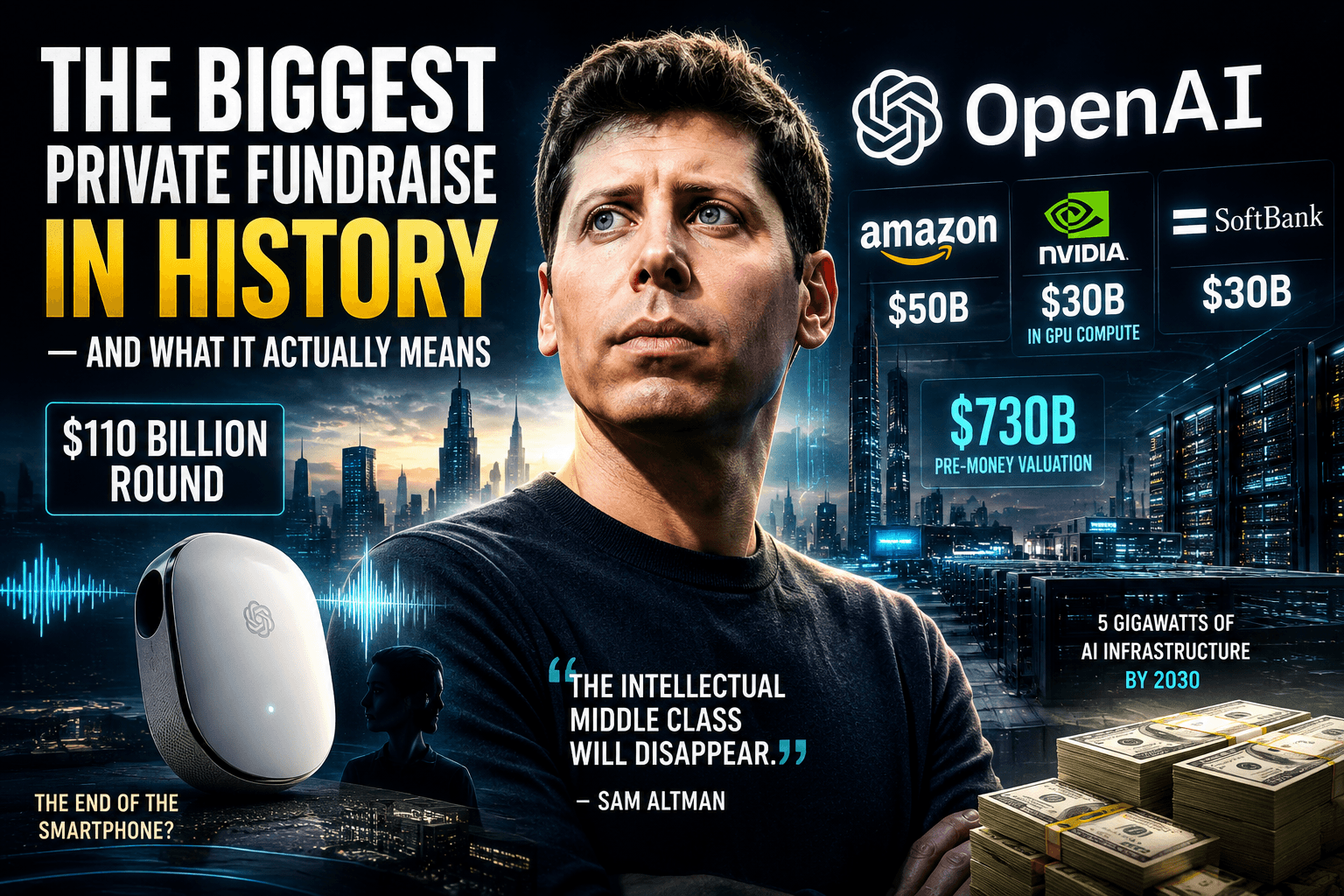
The Biggest Private Fundraise in History — and What It Actually Means
OpenAI just raised $110 billion. The valuation is larger than Berkshire Hathaway. The IPO is coming. And most people are focused on entirely the wrong part of the story.
In February 2026, Sam Altman sat down with CNBC and delivered the line the financial world had been waiting to hear: OpenAI had closed a $110 billion funding round — the single largest in the history of private technology. Amazon led with $50 billion, Nvidia committed $30 billion largely in dedicated GPU compute, and SoftBank rounded out the trio with another $30 billion.
The result: a $730 billion pre-money valuation that places OpenAI comfortably among the most valuable companies on earth — private or public.
For context, that number is larger than Berkshire Hathaway, larger than Visa, and roughly equal to the entire GDP of Switzerland. And OpenAI hasn't gone public yet. For retail investors, career professionals, and anyone holding a smartphone — this is not just a headline. It is a directional signal about where the most sophisticated capital in the world believes the next decade will be decided.
OpenAI's valuation climbed from $300 billion in March 2025 to $730 billion by February 2026 — in under twelve months.
Segment 01 The Hardware Gamble — Killing the Smartphone
Buried beneath the funding headlines is perhaps Altman's most audacious bet: that the smartphone — a product category that has shaped human behavior for seventeen years — is the wrong interface for intelligence. Not merely outdated. Wrong in its fundamental design.
To execute that vision, he went after the one person who understands iconic hardware better than anyone alive. Jony Ive — the designer behind the original iPhone, iPod, and iMac — joined OpenAI in a $6.5 billion acquisition of his hardware company, IO Products, in May 2025.
The device, referred to internally as "io", is described by people close to the project as primarily audio-based: a wearable or ambient companion that is always-listening, always-contextual, and deliberately screen-free. Altman's thesis is blunt — screens compete for attention rather than augment intelligence. Voice, spatial awareness, and ambient context are the right primitives.
The AI Pin from Humane — a well-funded, well-designed ambient AI wearable — launched in 2024 and failed commercially within a year. What separates "io" from that precedent is the combination of Ive's track record, Altman's distribution through ChatGPT's 800-million-user base, and the underlying model capability that simply didn't exist eighteen months ago. None of those three elements were present in Humane's attempt.
A 2026 launch window is being targeted. If the product lands — even partially — the implications cascade through consumer electronics, telecom, and digital advertising simultaneously. Apple, Google, and Samsung each have enormous incentives to ensure it fails. That competitive pressure alone tells you how seriously the industry is taking it.
Segment 02 "The Intellectual Middle Class Will Disappear"
No statement from Altman in 2026 has generated more heat than his prediction about the labor market. In remarks that spread quickly across financial and technology circles, he argued that AI would hollow out the "intellectual middle class" — the broad layer of the workforce performing high-cognitive, routine white-collar tasks: paralegals, junior analysts, entry-level engineers, copywriters, researchers.
His framing was deliberately binary. In the new economy, workers fall into one of two categories: those who use AI to multiply their output by an order of magnitude, and those who are displaced by someone who does. There is no comfortable middle lane of "I'll figure it out eventually."
Economists are divided on the timeline, but not the direction. Historical disruptions — the industrial revolution, the PC era, the early internet — ultimately created more jobs than they destroyed. The counterargument, and it is a serious one, is that those transitions unfolded over decades and were geographically uneven. Generative AI is neither slow nor geographically bounded.
The question isn't whether AI replaces some jobs — it already is. The real question is whether it replaces them faster than new ones emerge, and whether those new roles are accessible to the people being displaced. History says yes. But history has never seen a disruption with this velocity and this reach simultaneously.
More than 800 million people use ChatGPT every week. The ramp is global. The adoption curve looks less like the internet rollout and more like the adoption of the mobile phone — compressed, borderless, and deeply embedded in daily behavior within years, not decades.
Segment 03 The Security Crisis — and the Price of Visibility
In April 2026, Altman's San Francisco home was targeted in two separate incidents — a Molotov cocktail attack and a shooting — within days of each other. Nobody was injured. But the events triggered a sustained national conversation about the social temperature surrounding AI leadership.
Altman is not alone. Executives at multiple major AI labs have reported a marked increase in credible threats and hostile correspondence over the past eighteen months. The pattern has a historical parallel that is worth examining plainly.
During the Luddite movement of the early nineteenth century, textile workers systematically destroyed the machinery they believed was eliminating their livelihoods. The movement was eventually suppressed, but not before it demonstrated that technological displacement, when it moves faster than society can adapt, produces organized resistance — not passive acceptance.
The question for 2026 is whether AI leaders — like the factory owners of that era — can build sufficient social goodwill through profit-sharing, retraining investment, or policy engagement to avoid a more systematic backlash. The evidence so far is mixed.
Segment 04 The Investor Angle — Is $730 Billion Defensible?
For finance-focused readers, the valuation math deserves honest scrutiny rather than reflexive enthusiasm. OpenAI is projecting revenues exceeding $280 billion by 2030, with roughly equal contributions from consumer and enterprise segments. At a $730 billion pre-money valuation, that implies a forward price-to-sales ratio of approximately 2.6x on 2030 revenue — aggressive by conventional standards, but not irrational if the growth trajectory holds.
- 01 The $110B isn't what it looks like. Only ~$25 billion is confirmed immediate cash. Amazon's remaining $35 billion tranche is conditional on undisclosed milestones. Nvidia's $30 billion is largely compute credit, not currency. The headline number is real — the liquidity picture is more nuanced.
- 02 Competition is intensifying fast. Anthropic raised $30 billion at a $380 billion valuation in the same month. Google's Gemini is embedding into billions of existing Android and Search users daily. Meta is open-sourcing frontier models that erode moat by design. OpenAI leads — but the lead is not structural.
- 03 The IPO is the most significant near-term catalyst. When OpenAI goes public — likely late 2026 or early 2027 — it will be the first time ordinary investors can own shares directly. That event will reprice the entire AI sector, not just OpenAI. Watch Amazon's second tranche closely: its activation is likely the clearest leading indicator that an IPO filing is imminent.
Deep Dive What $600 Billion in Compute Actually Builds
OpenAI is targeting $600 billion in total compute spend by 2030. In physical terms, that translates to approximately five gigawatts of AI data center capacity — the output equivalent of five large nuclear power plants running simultaneously, dedicated entirely to running AI models.
This is no longer purely a software story. It is an infrastructure story, an energy story, and increasingly a real estate story. The supply chain implications ripple through copper, silicon, land, water rights, and power grids across the United States — and beyond.
That physical footprint creates a category of investment that most retail investors are not tracking because it doesn't appear in the AI stock screener: the power utilities, data center REITs, industrial cooling specialists, and fiber networking companies that will sell the picks and shovels regardless of which AI model wins the next benchmark.
Equivalent to 5 nuclear power plants running 24/7 — dedicated entirely to AI infrastructure. The energy sector may be the most underappreciated AI trade of this decade.
Takeaways What You Should Actually Do With This
Track Amazon's $35B conditional tranche — it's likely IPO-linked. Watch Anthropic's next round as a valuation benchmark. Consider AI infrastructure plays (power, cooling, fiber) as quieter but structurally durable exposure to the same thesis.
Altman's binary is too stark, but the direction is correct. AI proficiency is no longer a differentiator — it is table stakes. The question is how fast you move from casual user to power user. That gap is widening every quarter.
Sam Altman is not the first to stand at the intersection of financial power and civilizational disruption. How the upside gets distributed — and to whom — will define the social contract of the next decade more than any product launch.
CNBC (Feb 27, 2026) · Bloomberg (Feb 27, 2026) · Tech-Insider.org (Apr 6, 2026) · TechRadar (Jan 5, 2026) · MacDailyNews (Jan 2, 2026)