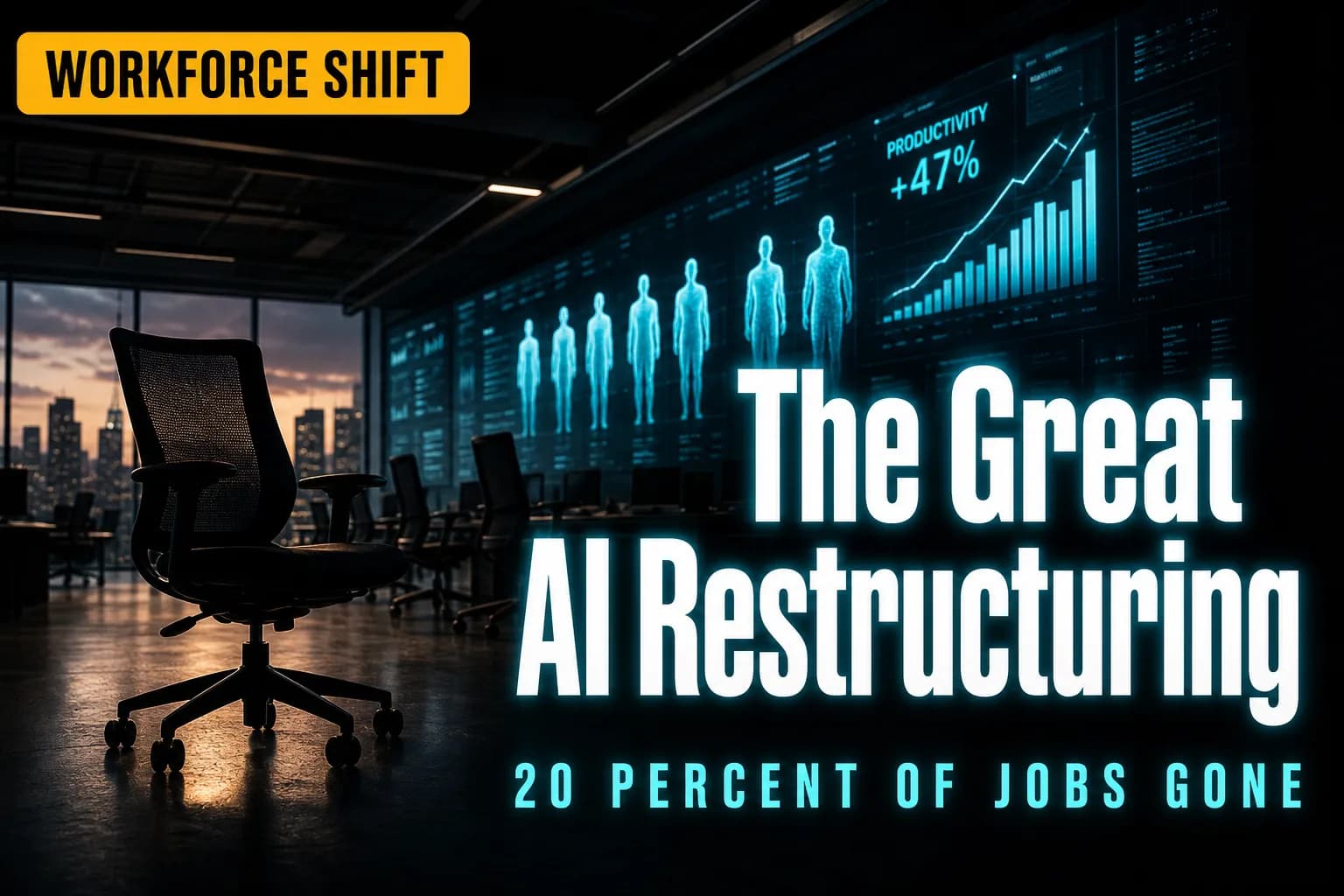
The AI Layoff Wave: Why Tech Giants Are Cutting 20% of Workers in 2026
The numbers are staggering. PayPal plans to eliminate roughly 20% of its 23,800-person workforce over the next two to three years, totaling about 4,760 jobs. Coinbase announced it would cut approximately 14% of staff, or roughly 700 employees.
But this isn't your typical cost-cutting exercise during a downturn.
The economy is actually growing, profits are up, and these companies are thriving.
This is something entirely different: a fundamental restructuring of how work gets done, powered by the rapid advancement of artificial intelligence capabilities in 2026.
The Restructuring Thesis
PayPal CEO Enrique Lores told investors the company will:
“remove duplication and layers from our organizational structure” and “accelerate AI adoption and automation across operations.”
Coinbase CEO Brian Armstrong framed the decision as a structural shift toward smaller, AI-augmented teams.
The bet is clear: Three people with powerful AI tools can now accomplish what previously required ten.
- Marketing teams that once needed twenty copywriters now operate with five strategists directing AI content generators.
- Customer service departments that employed hundreds are transitioning to AI chatbots with human escalation specialists.
- Software engineering teams are shrinking as AI coding assistants handle routine implementation work.
This represents a fundamental rethinking of organizational design. For decades, companies scaled by adding headcount. Now they're scaling by multiplying individual productivity through AI leverage.
The AI Capabilities Driving the Shift
What changed in 2026 to make this possible? The answer lies in the rapid evolution of AI agents and reasoning models.
AI agents are becoming digital coworkers, helping individuals and small teams punch far above their weight.
What AI Handles Now:
- Data analysis
- Content generation
- Workflow automation
- Personalization
- Research synthesis
- Repetitive operational tasks
What Humans Increasingly Focus On:
- Strategy
- Creativity
- Decision-making
- Oversight
- Relationship management
These are no longer simple chatbots. Modern AI systems can understand context, maintain memory across workflows, execute multi-step tasks, coordinate tools autonomously, and operate with minimal human supervision.
The productivity gains are already measurable. According to Stanford AI Index research:
- AI boosts productivity by roughly 14% in customer service.
- AI improves productivity by approximately 26% in software development.
But those numbers only tell part of the story. The real transformation happens when companies redesign entire workflows around AI capabilities instead of merely adding AI on top of existing processes.
The Economic Paradox
Here's what makes this moment so unusual: companies are cutting jobs while simultaneously reporting strong financial performance and optimistic growth projections.
Traditional economic signals suggest this shouldn't be happening:
- Unemployment remains relatively low
- GDP growth is positive
- Corporate earnings remain healthy
Yet layoffs continue accelerating. The explanation lies in how companies now view competitive survival.
In previous technological waves, adopting new tools late meant losing market share. Today, executives increasingly believe that hesitating on AI integration could become existential. Companies restructuring aggressively around AI may gain massive advantages in:
- Operational efficiency
- Speed to market
- Cost structure
- Scalability
- Profit margins
This creates an uncomfortable dynamic: Individual companies are making rational decisions to remain competitive while collectively creating large-scale labor market disruption.
The Skills Gap Widens
The work that remains after AI restructuring looks fundamentally different from the work being eliminated.
| Roles Being Cut (AI Excels) | Roles Being Retained (Uniquely Human) |
|---|---|
| Repetitive tasks | Strategic thinking |
| Routine analysis | Creative problem-solving |
| Predictable workflows | Ethical judgment & Leadership |
| Standardized customer interactions | Emotional intelligence & Ambiguity management |
The challenge is that many displaced workers do not currently possess these skills at scale, and acquiring them requires significant time, education, and financial support.