
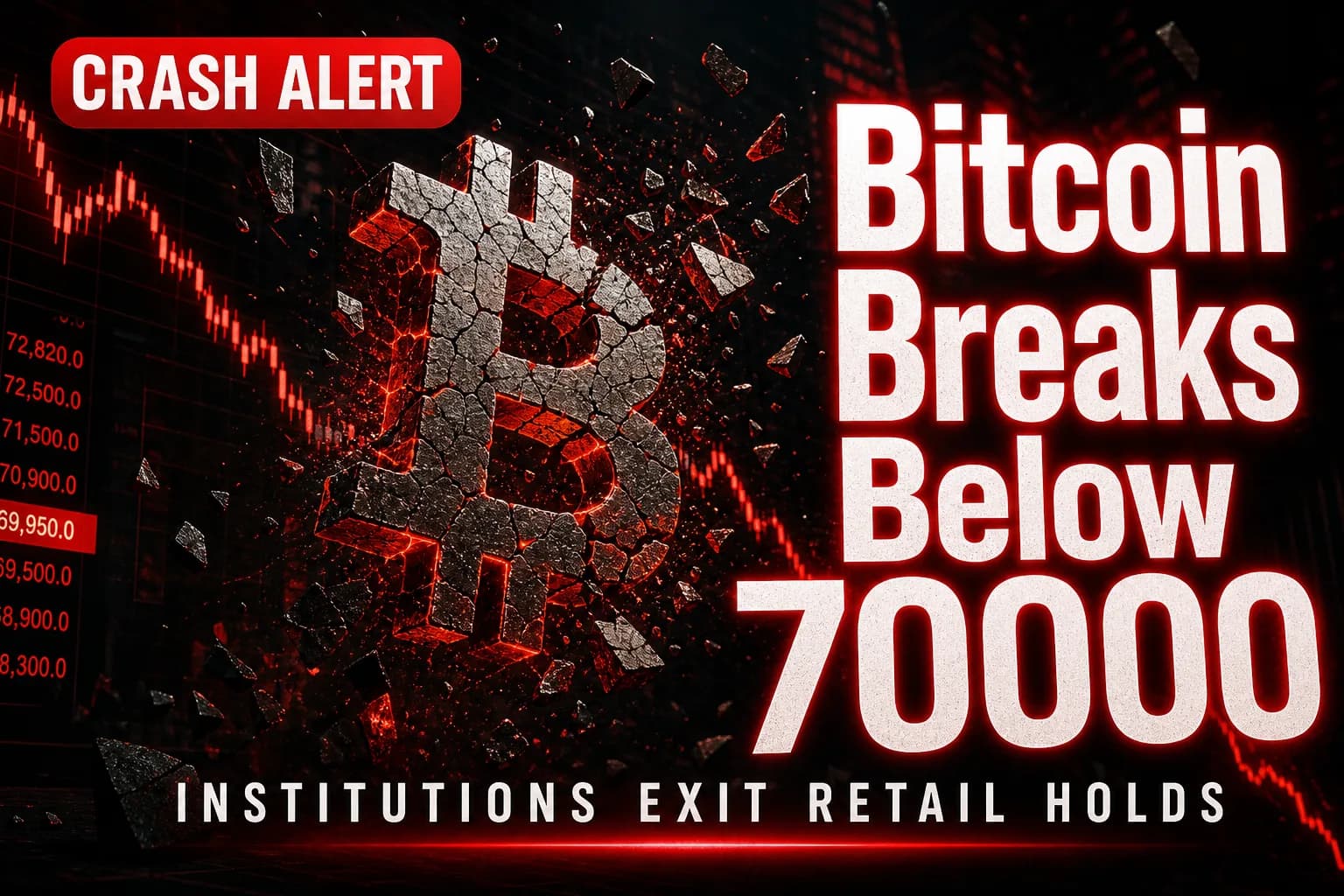
Bitcoin Crashes Below $70,000 — And the Sell Orders Are Coming From the Top
The bitcoin price drop below $70,000 that analysts warned about for months became reality on June 2, 2026. BTC touched an intraday low of $68,709 — a level not seen since the early stages of last year's bull cycle — erasing more than 45% of its value from the all-time high of $126,200 recorded in October 2025. In a single 24-hour window, the crypto market absorbed $767 million in liquidations, the majority hitting leveraged long positions.
This is not a typical retail-driven panic. The institutions that spent 2024 and 2025 lobbying for Bitcoin ETF approval, publishing six-figure price targets, and accumulating BTC on corporate balance sheets are now quietly — and in some cases, not so quietly — reducing their exposure. The divergence between who is selling and who is holding defines everything about what happens next.
The $70,000 Line Was Not Just Psychological — It Was Structural
In technical terms, $70,000 represented a confluence of critical support: the lower channel trendline, a cluster of the 20-, 50-, and 100-day exponential moving averages (EMAs) between $76,400 and $76,700, and the 0.236 Fibonacci retracement level at $73,869. Bitcoin lost each of these levels in sequence throughout May, closing the month down 4.4% at $73,751 — its third consecutive red monthly candle of 2026.
The RSI (Relative Strength Index) has dropped to approximately 35, approaching oversold territory. Historically, RSI readings below 30 have marked high-probability entry zones for long-term Bitcoin investors. But oversold does not mean finished falling. The 0.382 Fibonacci retracement sits at $68,348, and a confirmed close below that level opens the path to the $63,000–$65,000 range, which served as major resistance during the 2024 accumulation phase.
For traders, the critical level to watch is a three-day close above $73,869. Reclaiming that level shifts the short-term structure from bearish to neutral and targets $77,877 next. Below $68,348, price discovery opens downward.
Bitcoin's multi-week descent through key EMA clusters and the $70K psychological floor marks a decisive shift in 2026 market structure.

ETF Outflows Tell the Real Story
When Bitcoin ETFs launched in early 2024, they were framed as a one-way institutional on-ramp. The data from May 2026 rewrites that narrative. US spot Bitcoin ETFs recorded $2.30 billion in net outflows during May — the largest single-month exit of 2026 and the steepest since November 2025. This reverses two straight months of institutional buying: April had added $1.97 billion and March $1.32 billion in net inflows.
The asymmetry is striking. In February 2026, Bitcoin fell 14.8% while ETFs shed only $206 million. In May, Bitcoin fell just 3.69% — yet outflows were nearly 10 times larger. Institutions are not reacting to price decline. They are anticipating it, or repositioning ahead of something the public market has not fully priced in. The cumulative net inflow across all US spot Bitcoin ETFs has slipped from $58.09 billion in April to $55.79 billion today.
BlackRock's IBIT and Fidelity's FBTC absorbed the heaviest withdrawals. These are not retail accounts panic-selling. These are systematic redemptions from institutional allocators who built positions at higher prices and are now managing drawdown risk. The Fear & Greed Index has fallen to 23 — deep into "Extreme Fear" territory.
Mt. Gox Transfers Reignite an Old Fear
The second pressure point driving the bitcoin price drop below $70,000 is older than the ETF era: Mt. Gox. On-chain analysts identified the first major wallet movements from the defunct exchange's remaining holdings in nearly two months. The Mt. Gox estate still holds approximately 34,500 BTC, with creditor repayments scheduled through October 31, 2026.
The transfers themselves may not represent immediate selling — creditors receiving BTC years after the exchange's collapse may choose to hold or sell gradually. But the visibility of on-chain movement from a wallet associated with one of crypto's most infamous failures is enough to shift sentiment. In a market already operating under elevated fear, the optics function as a catalyst even when the fundamentals are ambiguous.
The timing compounds the macro pressure. Rising US inflation at 3.8%, geopolitical tensions, and a stock market that paradoxically reached new highs while BTC corrected have created a dissonant environment where crypto is absorbing risk-off behavior that equities are shrugging off.
Strategy's Sale and the Narrative Shift
Perhaps the most symbolically significant event in this correction was a disclosure buried in a June 1 SEC filing: Strategy Inc. (formerly MicroStrategy) sold 32 BTC between May 26 and May 31 for approximately $2.5 million, at an average price of $77,135 per coin. The proceeds funded preferred stock distributions.
The amount is trivial relative to Strategy's total Bitcoin holdings, which remain in the hundreds of thousands of coins. But the psychological effect is outsized. Michael Saylor's company has functioned as the de facto institutional floor under Bitcoin sentiment — a holder of last resort who publicly doubled down at every price level. Any sale, regardless of size, cracks that narrative. Short-term holders responded by selling at a loss and rotating into alternative assets including Zcash and Toncoin.
The crypto market correction is not happening in isolation. It is happening in a context where the most publicly committed institutional Bitcoin holder just filed a document confirming it sold coins.
US spot Bitcoin ETF net outflows hit $2.30 billion in May 2026 — roughly 10x the outflow rate relative to comparable price declines earlier in the year.

What the Bitcoin Rainbow Chart Reveals About Long-Term Value
Despite the severity of the current correction, long-term valuation models paint a different picture. The Bitcoin Rainbow Chart — a logarithmic regression model tracking BTC's historical price performance — currently places Bitcoin below its lowest projected valuation band for June 2026. To enter even the "Bitcoin is dead" zone (the chart's most pessimistic band), BTC would need to be trading at $78,900.
