A 3.5% dividend yield sounds unimpressive until you realize $100 a month for 20 years, reinvested, can generate over $200 a month in passive income by year 20 — and that's before accounting for dividend growth. That's the real number behind the SCHD math currently circulating, and it's the clearest entry point for anyone asking how to passive income without a six-figure head start.
This isn't a stock pick article. It's a model. Once you understand how the mechanics work with a fund like the Schwab U.S. Dividend Equity ETF (SCHD), you can apply the same framework to any diversified dividend ETF, any contribution amount, and any timeline. The point is the system, not the ticker.
How to Passive Income Starting With Just $100 a Month
SCHD currently yields around 3.5%, holding roughly 100 U.S. companies with a history of consistent dividend payments and free cash flow strength — names like Chevron, Home Depot, and Verizon rotate through its top holdings. The fund also has a track record of raising its per-share payout most years, averaging high-single-digit dividend growth over the past decade.
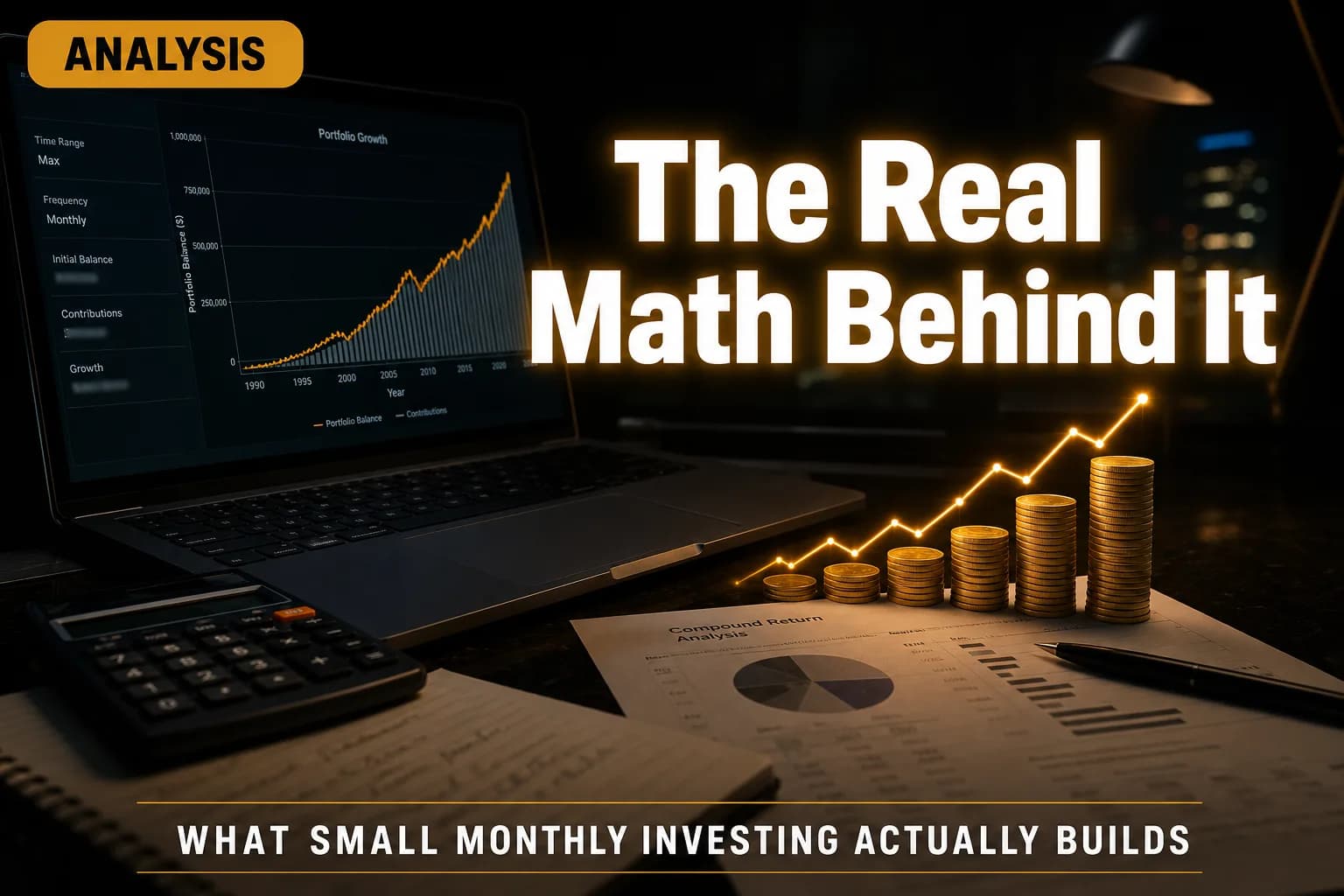
Here's the model most people run: $100 invested monthly, dividends fully reinvested, an assumed 8% average annual total return (blending price appreciation and dividend growth, in line with SCHD's long-run history since its 2011 launch). After 20 years, the account balance lands near $58,900. At a 3.5% yield on that balance, the annual dividend income comes to roughly $2,065 — about $172 a month, arriving without you lifting a finger.
Compare that to the alternative most beginners actually attempt: picking individual dividend stocks, timing entries, and hoping for stability. SCHD's beginners get instant diversification across sectors and instant exposure to dividend growth, which is the compounding force that turns "how to passive income" from a Google search into an actual account statement.

stack of coins growing chart.
Why the 8% Assumption Isn't a Guarantee
Every compounding projection is a bet on the past repeating. SCHD launched in October 2011 and has delivered strong total returns since, but it also fell over 12% during the 2022 market drawdown alongside the broader value/dividend complex. A 20-year runway smooths short-term volatility, but it doesn't eliminate the possibility of a decade like 2000-2009, when U.S. equities delivered close to nothing in total return.
The dividend itself isn't guaranteed either. SCHD's underlying index, the Dow Jones U.S. Dividend 100, screens companies on cash flow to debt, return on equity, dividend yield, and five-year dividend growth — but it rebalances and reconstitutes annually, meaning holdings and payouts shift. A company can be dropped if its fundamentals deteriorate, which is a feature, not a flaw, but it means the 3.5% yield you see today isn't locked in for 20 years.
Inflation also erodes the real value of that future $172 a month. At 3% average annual inflation, $172 in year-20 dollars buys what roughly $95 buys today. The nominal number is real money, but the purchasing power is smaller than the sticker price suggests.
What Changes If You Invest More Than $100
The math scales linearly in a way that makes the case for starting small and increasing later. At $250 a month under the same 8% assumption, the 20-year balance reaches approximately $147,300, throwing off around $5,155 a year, or $430 a month, in dividend income. At $500 a month, the number climbs to roughly $294,600 in principal and about $860 a month in passive income.
The bigger lever isn't the monthly amount — it's time. An investor who starts at $100 a month for 20 years and then stops contributing but stays invested for 10 more years watches that $58,900 balance grow to over $127,000 through compounding alone, assuming the same 8% return holds. Someone who waits five years to start and then invests $150 a month for 15 years to "catch up" ends up with less money and less income than the person who started small and stayed consistent.

calendar with growing dollar bills.
How SCHD Income Compares to Other Passive Income Methods
Dividend ETF investing is one of the lowest-friction ways to build passive income, but it's not the only one, and beginners researching how to passive income should know the tradeoffs.
- Real estate rental income can generate higher yields (6-10% cash-on-cash in some markets) but requires a large down payment, active management or a property manager, and exposure to vacancy and maintenance risk.
- High-yield savings accounts and CDs currently pay 4-5% with zero volatility, but that income doesn't grow over time and inflation can outpace it if rates fall.
- Bond ladders offer predictable income and lower volatility than equities, but historically deliver lower long-run total returns than dividend growth equities like SCHD.
- Dividend ETFs like SCHD trade some yield today (3.5%, lower than a savings account) for dividend growth and price appreciation over time, which is why the 20-year number beats a static-yield product.
None of these is objectively "best." They solve different problems. SCHD-style investing solves the problem of turning small, automated contributions into a growing, compounding income stream without requiring you to manage tenants or time interest rate cycles.