
The New Pitch: Passive Income Vending Machines That Print Cash
A viral claim is making the rounds: passive income vending machines can generate up to $40,000 a month for the right operator, with none of the headaches that come with rental property. The investor behind the claim calls vending machines "the only true one-and-done asset" — buy it, place it, forget it. That's a bold statement in a world where "passive income" usually means anything but.
The appeal is obvious. No tenants skipping rent, no burst pipes at 2 a.m., no property management fees eating 10% of your revenue. Just a machine, a location, and a restocking route. But does the math actually hold up, or is this another inflated social-media flex dressed up as financial advice?
Why Vending Machines Are Being Called the "One-and-Done" Asset
The phrase "one-and-done" is doing a lot of work here. Unlike rental real estate — which demands financing, insurance, maintenance calls, and tenant management — a vending machine is a discrete, self-contained unit. You buy it once, typically for $2,000 to $5,000 for a quality combo machine, and it doesn't depreciate the way a car does or require the ongoing capital injections a rental property does.
Compare that to Airbnb arbitrage or dividend investing, two other popular passive income plays. Short-term rentals require furnishing, guest communication, and cleaning turnover — arguably more active than passive. Dividend stocks are genuinely hands-off, but a $40,000-a-month dividend stream would require a portfolio north of $10 million at a 4-5% yield. Vending machines, by contrast, can theoretically hit similar monthly numbers with an investment in the tens of thousands, not millions.

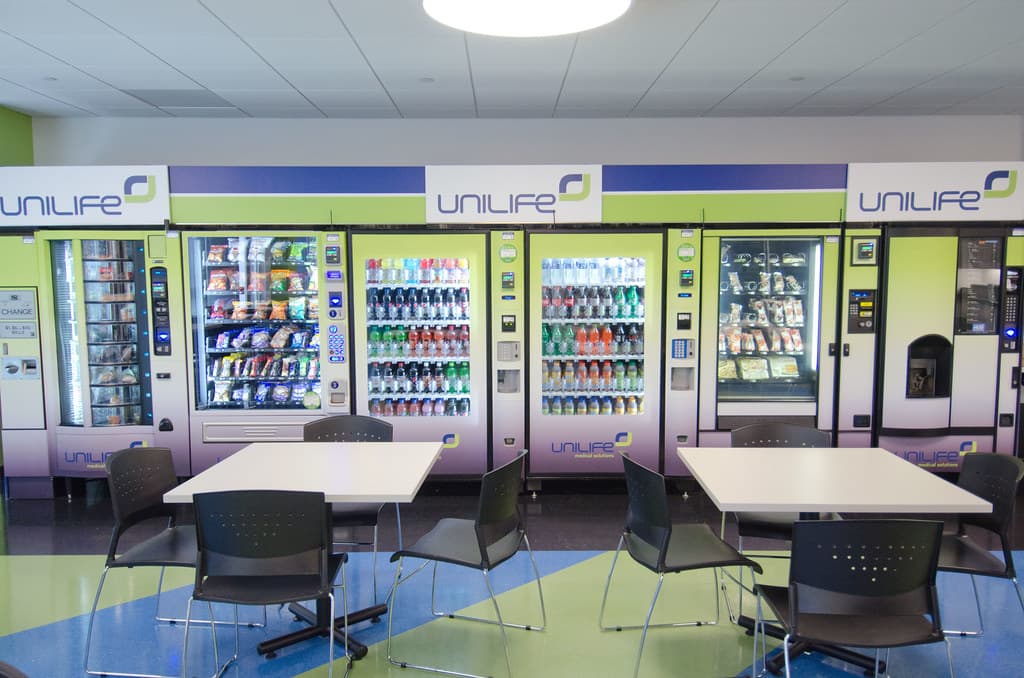
rows of modern vending machines.
Breaking Down the $40,000-a-Month Math
Here's where the claim needs scrutiny. A single well-placed vending machine in a high-traffic location — a gym, office building, or hospital — can net $200 to $500 in monthly profit after restocking costs and location commissions, according to industry estimates from the National Automatic Merchandising Association. To hit $40,000 a month, an operator would need somewhere between 80 and 200 machines running simultaneously.
That's not a side hustle anymore — that's a logistics operation. The investor's real strategy, as reported, likely involves a portfolio built over years, reinvesting profits from early machines into new units and locations. Smart vending operators also diversify into micro-markets (unmanned mini convenience stores) and smart lockers, which carry higher price points and margins than a standard snack machine.
Location quality is the single biggest lever. A machine in a low-foot-traffic break room might clear $50 a month, while one in a 500-employee distribution center or a busy hospital corridor can clear $1,000-plus. The "one-and-done" framing applies to each individual unit, but scaling to $40,000 monthly still requires active sourcing of locations, negotiating placement agreements, and managing a restocking schedule — even if you outsource it.
The Real Startup Costs Nobody Mentions
Getting into vending isn't purely plug-and-play. A new combo machine (snacks and drinks) runs $3,000 to $10,000 depending on features like card readers and remote monitoring. Used machines can be found for $1,200 to $2,500, but carry higher breakdown risk and no warranty.
Then there's inventory. Stocking a single machine costs $150 to $300 per restock cycle, and most operators restock every one to two weeks. Add fuel, a reliable vehicle, and potentially a part-time route driver once you scale past 10-15 machines, and the "passive" label starts to blur.
Location commissions — the cut paid to property owners for hosting your machine — typically range from 5% to 25% of gross sales, and can make or break a location's profitability.
Route software and remote monitoring systems (like Cantaloupe or Nayax) add another layer of cost, usually $10-$30 per machine monthly, but they're often what separates a hobbyist from someone running a real semi-passive income vending machines operation at scale.
investor reviewing profit spreadsheet.
How This Compares to Other Passive Income Ideas in 2025
Vending sits in an interesting middle ground on the passive income spectrum. It's more capital-efficient than real estate — no 20% down payment, no mortgage underwriting, no property taxes. It's also more tax-advantaged in the early years, since equipment purchases often qualify for Section 179 depreciation, letting operators write off the full machine cost in year one.