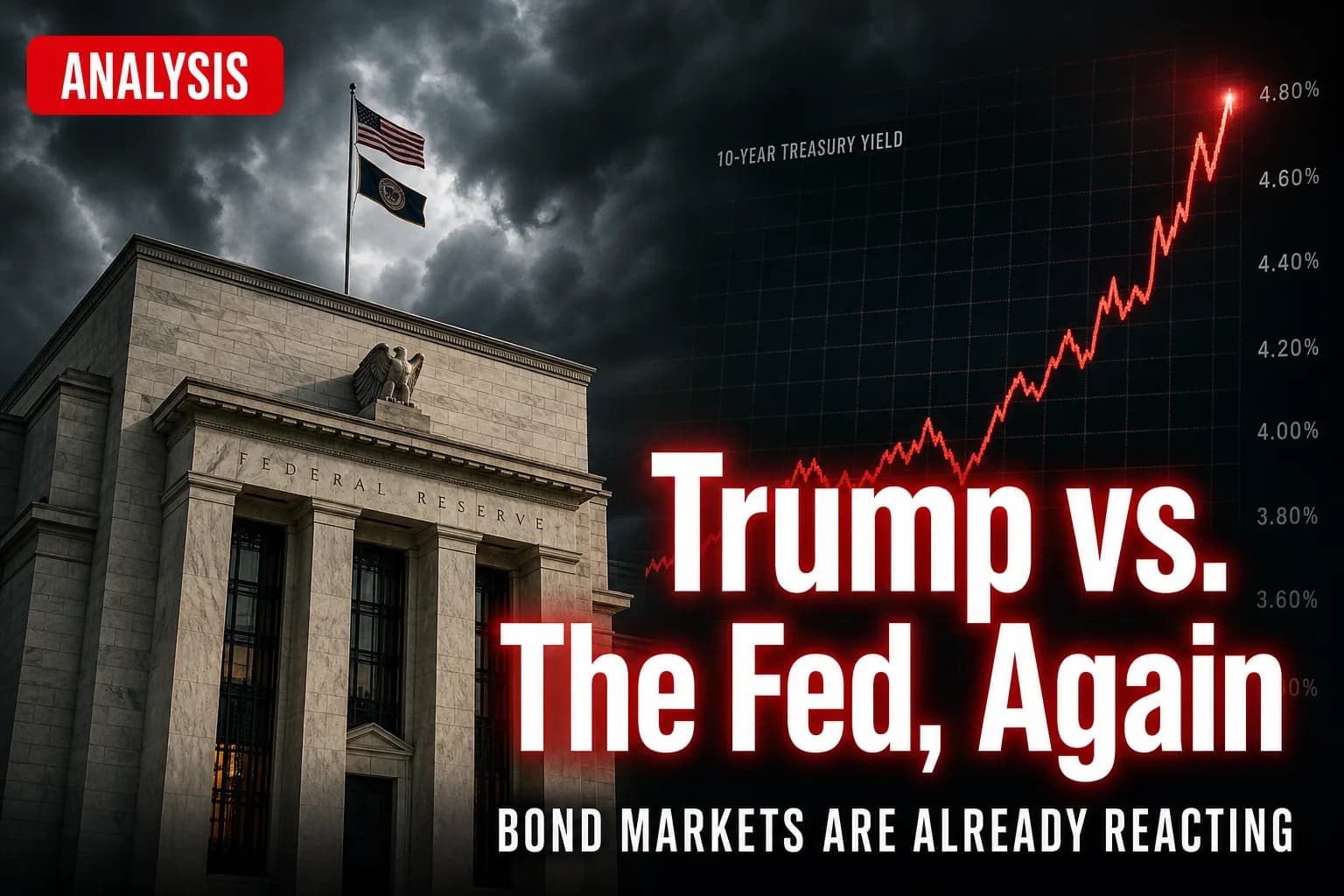
Kevin Warsh, a former Federal Reserve governor and a name repeatedly floated to replace Jerome Powell, said publicly this week that inflation remains too high — and traders responded by pricing in the possibility of rate hikes instead of the cuts markets spent most of 2024 and 2025 betting on. That single statement, reported by NPR, has reopened a debate that sounds academic but isn't: is inflation needed for economic growth, or has the Fed's tolerance for above-target inflation become the actual threat to the expansion?
The stakes are not abstract. Mortgage rates, high-yield savings APYs, bond prices, and stock valuations are all built on the assumption that the Fed's next move is down, not up. Warsh's comments, and the market repricing that followed, suggest that assumption is no longer safe.
What Kevin Warsh Actually Said and Why Traders Reacted
Warsh's warning centers on a specific claim: inflation readings the Fed and markets have treated as "close enough" to the 2% target are not actually consistent with price stability. He has argued in prior public remarks that the Fed's framework — averaging inflation over time and tolerating overshoots — let price growth become sticky in categories like housing services and insurance that don't respond quickly to rate policy.
The market reaction was immediate and measurable. Fed funds futures, which had priced multiple cuts through the back half of 2025, showed reduced odds of near-term easing and a small but real probability of a hike within the pricing window, according to CME FedWatch data cited in coverage of the story. That's a meaningful shift from a market that had been almost unanimously positioned for continued rate relief.
Warsh is not currently a voting Fed official — he left the Board of Governors in 2011. His influence comes from his standing as a potential Trump administration pick for Fed Chair when Powell's term ends in May 2026, which means his framework for inflation could become actual policy, not just commentary.
Who Gains and Who Loses If Hikes Return
Savers and retirees win. Anyone holding cash in high-yield savings accounts, money market funds, or short-term CDs benefits directly from rates staying elevated or rising further. A saver with $50,000 in a 4.5% APY account earns $2,250 a year; if the Fed hikes instead of cutting, that yield could hold or climb rather than compress toward 3%.
Recent and prospective homebuyers lose. The average 30-year mortgage rate has hovered in the high-6% to low-7% range through 2025, already locking many buyers out. A reversal toward hikes removes the relief that housing economists had penciled in for 2026, keeping monthly payments elevated on a median-priced home.
Bondholders in long-duration funds lose on price, gain on new issuance. Existing long-term Treasury and corporate bond prices fall when rate expectations rise, because their fixed coupons become less attractive relative to new issuance. Anyone who bought long-duration bond funds anticipating cuts is now sitting on potential mark-to-market losses.
Growth stocks and highly leveraged companies lose disproportionately. Tech and small-cap names priced for a lower discount-rate future get hit hardest when hike odds increase, because their valuations depend more heavily on cheap future capital. Dividend payers and companies with strong balance sheets and low debt are comparatively insulated.

Federal Reserve building exterior.
Is Inflation Needed for Economic Growth, or Is That the Wrong Question
The honest answer, grounded in decades of Fed research, is that mild, predictable inflation — the Fed's 2% target — does support growth by encouraging spending and investment over hoarding cash. Deflation, by contrast, has historically been far more damaging, because falling prices delay consumption and can trigger debt spirals, as seen in Japan's multi-decade struggle. That's the textbook case for why is inflation needed for economic growth at some low, stable level.
But Warsh's argument isn't that inflation should be zero. It's that inflation running persistently above target — even at 3% instead of 2% — erodes real wages, distorts long-term investment decisions, and forces the Fed into a credibility problem where markets stop believing future inflation will actually come down. That's a different claim than "inflation is bad," and it's the one that matters for the current policy fight.
The Strongest Case Against Warsh — and Why It Doesn't Fully Hold
The strongest counterargument is straightforward: inflation has already fallen substantially from its 2022 peak of above 9%, and recent CPI prints have been much closer to the Fed's target than the headline "inflation is too high" framing suggests. Critics of Warsh's position argue that hiking rates into a cooling labor market risks tipping the economy into a recession to fight a problem that's mostly solved, and that the last mile of disinflation is naturally slower and doesn't require a policy overreaction.