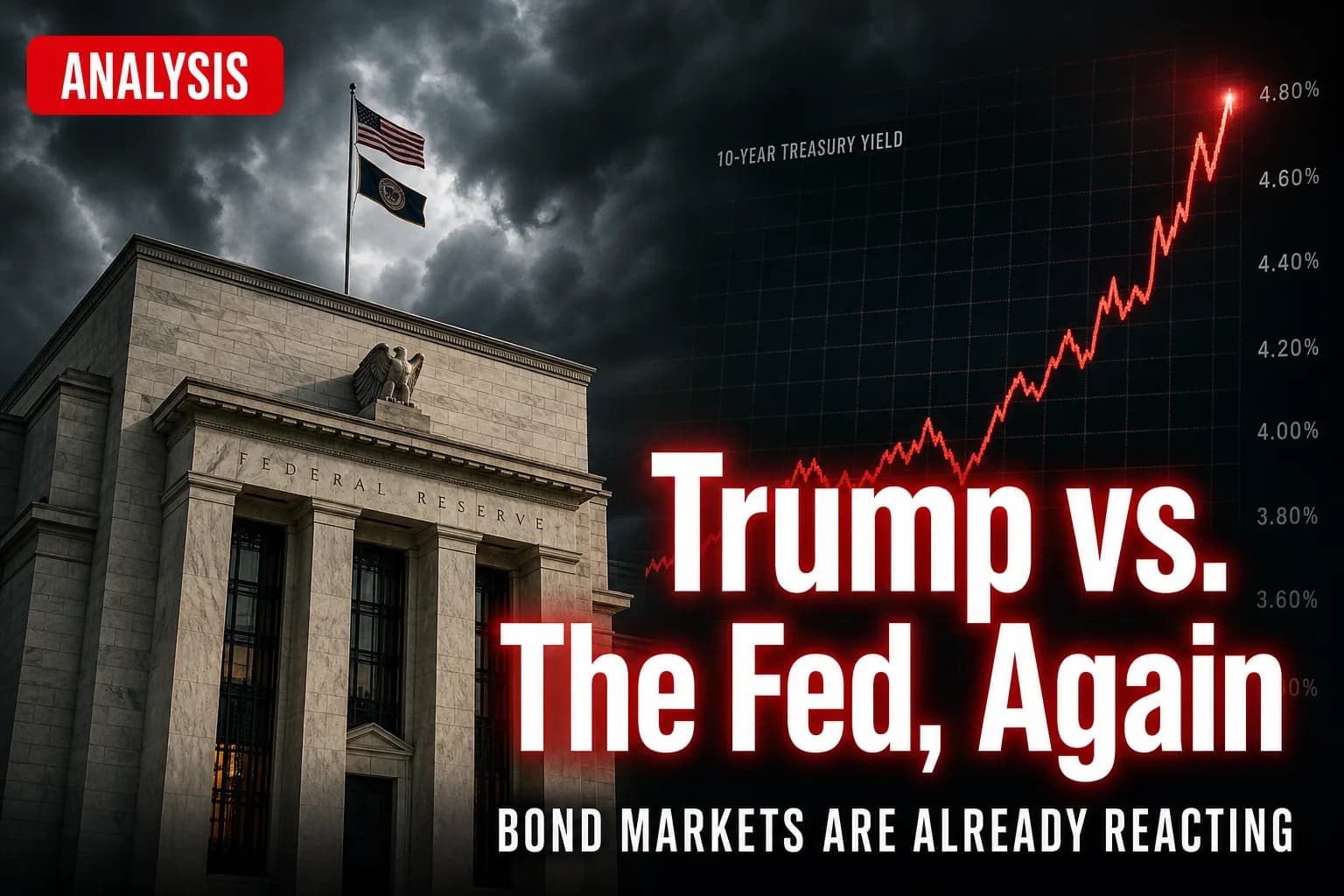
The 10-year Treasury yield doesn't care about politics — until politics makes the Federal Reserve's independence look negotiable, and then it cares immediately. That's the situation bond markets are in right now, as President Trump has reopened a public campaign against the Fed, reviving pressure tactics that traders had hoped were behind them. The Trump Fed bond market conflict isn't an abstraction for anyone with a mortgage, a savings account, or a bond fund in their 401(k) — it shows up directly in the interest rate you pay and the yield you earn.
This is not the first round. Trump spent much of his first term publicly criticizing then-Fed Chair Jerome Powell for not cutting rates fast enough, calling him "clueless" and worse in a string of posts and remarks. What's different now, according to Reuters' reporting, is timing: this renewed pressure campaign is landing while bond markets are already jumpy over deficits, sticky inflation readings, and questions about who will run the Fed once Powell's term ends. Layering political interference risk onto that backdrop is what has traders and strategists worried.
What Actually Happened This Week
Trump renewed direct criticism of the Federal Reserve and its interest rate policy, according to Reuters, at a moment when bond markets are already on edge over fiscal deficits and the path of inflation. The renewed attacks raise the specter of a president trying to influence monetary policy through public pressure rather than through the normal, insulated channels the Fed was designed to operate within.
Bond markets responded to earlier speculation about Fed independence with rising long-term yields — the market's way of demanding higher compensation for holding debt when the institution setting short-term rates looks politically compromised. Reuters notes this dynamic is precisely why the renewed conflict matters now: it isn't happening in a calm market, it's happening in one already sensitive to any signal that the Fed might bend to political will rather than economic data.
The mechanism here is not mysterious. Bond investors price in expectations for future inflation and future Fed policy. If they believe political pressure could push the Fed toward looser policy than the data justifies — cutting rates to please a president rather than to fight inflation — they demand a higher term premium on long-dated bonds to compensate for that risk. That premium shows up as higher yields, and higher yields on the 10-year Treasury translate almost directly into higher mortgage rates.

Federal Reserve building tense standoff.
Who Gains and Who Loses When the Fed Fight Escalates
This conflict does not hit everyone the same way, and pretending otherwise flattens a story that has real winners and losers.
Who loses:
- New mortgage borrowers. Mortgage rates track the 10-year Treasury yield closely. If political pressure pushes long-term yields higher on inflation-risk fears, anyone shopping for a home loan pays more, not less — even if the Fed's short-term rate falls.
- Existing long-duration bondholders. Bond prices move inversely to yields. Investors holding long-term Treasuries or bond funds see the market value of those holdings drop when yields rise on political-risk repricing.
- Fixed-income retirees. Anyone relying on bond income for cash flow faces a double bind: existing holdings lose value while new purchases require accepting either more risk or more volatility to get comparable yield.
Who potentially gains:
- Savers with short-term CDs and money market funds, if the Fed is pressured into cutting short-term rates while long-term yields stay elevated or rise — a steepening yield curve that can actually benefit those parking cash short-term, at least temporarily.
- Variable-rate borrowers, in the narrow scenario where short-term policy rates fall due to political pressure, could see near-term relief on things like credit card APRs tied to the prime rate — though this is offset by inflation risk building back into the system.
- Equity investors in rate-sensitive growth sectors, if markets interpret lower policy rates as stimulative in the short run, though this reaction has historically proven unstable when the rate cuts are viewed as politically motivated rather than data-driven.
The asymmetry matters: the losses (higher mortgage rates, bond portfolio losses) tend to be immediate and mechanical, while the gains are conditional, smaller, and often reversed once inflation expectations catch up.
The Strongest Case Against This Framing — and Why It Still Holds
The strongest pushback against this entire narrative is straightforward: presidents have criticized the Fed for decades, and the Fed has weathered it. Lyndon Johnson berated Fed Chair William McChesney Martin. Richard Nixon pressured Arthur Burns before the 1972 election, arguably contributing to the inflation of the 1970s. Bond markets survived those episodes and eventually normalized.
That argument has real force, but it misses what's specific to this moment. The 1970s Nixon-Burns episode is actually the cautionary tale, not the reassurance — it's the textbook case of political pressure producing looser policy that fed into double-digit inflation later in the decade. Historical precedent for presidential criticism of the Fed existing doesn't mean the outcomes were costless; it means the costs took years to show up in the data, which is exactly the risk bond markets are trying to price in advance today.
The second part of the counterargument — that markets have priced in Fed criticism before without lasting damage — is more solid, but it depends on investors believing the Fed's institutional independence remains intact regardless of rhetoric. Reuters' reporting on this renewed conflict lands specifically because it's happening alongside a separate, concrete process: speculation about who Trump would appoint to lead the Fed once Powell's term ends. Rhetoric plus an actual appointment pathway is a materially different risk than rhetoric alone.